

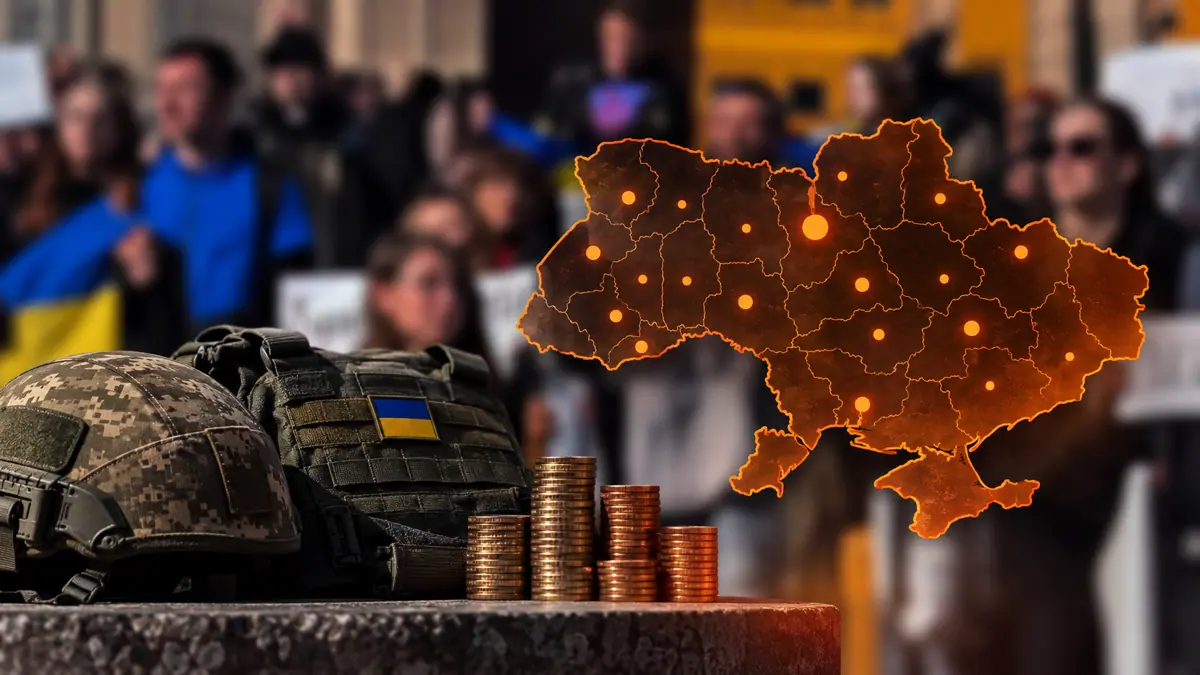
Since the start of the full-scale invasion, Ukrainian cities have reported billions of hryvnias directed to support the Defence and Security Forces. But absolute figures do not give the full picture.
UAH 27.4 billion from Kyiv sounds much more convincing than UAH 2.5 billion from Zhytomyr. However, the capital's budget for the period studied was over UAH 355 billion, while Zhytomyr's budget revenues were UAH 19.3 billion.
That is why in the "Money for the AFU" rating NGO "RESISTANCE" compared not only spending amounts, but also the share of funds for the Defence and Security Forces in the total revenues of city budgets in 2022-2025.
§ 01Which regional centres allocated the largest share of their budget
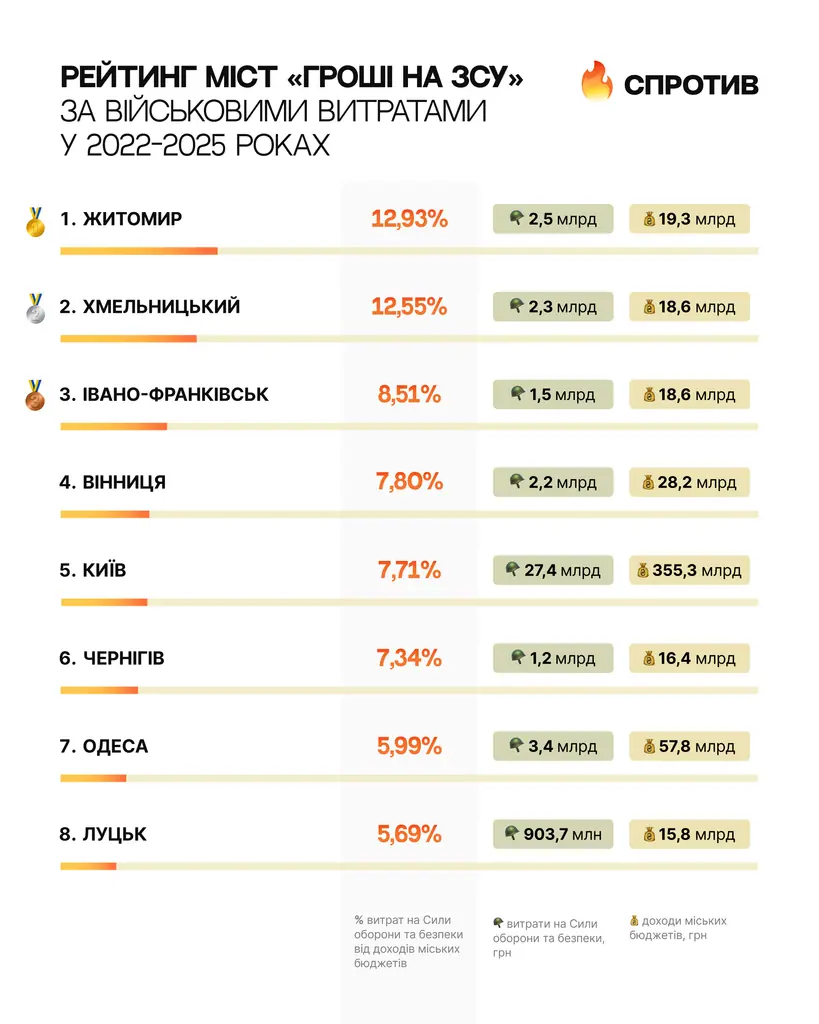
First place went to Zhytomyr - 12.93%. Over four years the city directed about UAH 2.5 billion to the needs of the Defence and Security Forces with budget revenues of UAH 19.3 billion.
In second place is Khmelnytskyi with 12.55%: UAH 2.3 billion in military spending with UAH 18.6 billion in revenues.
The top three is rounded out by Ivano-Frankivsk - 8.51%, or about UAH 1.5 billion out of UAH 18.6 billion in revenues.
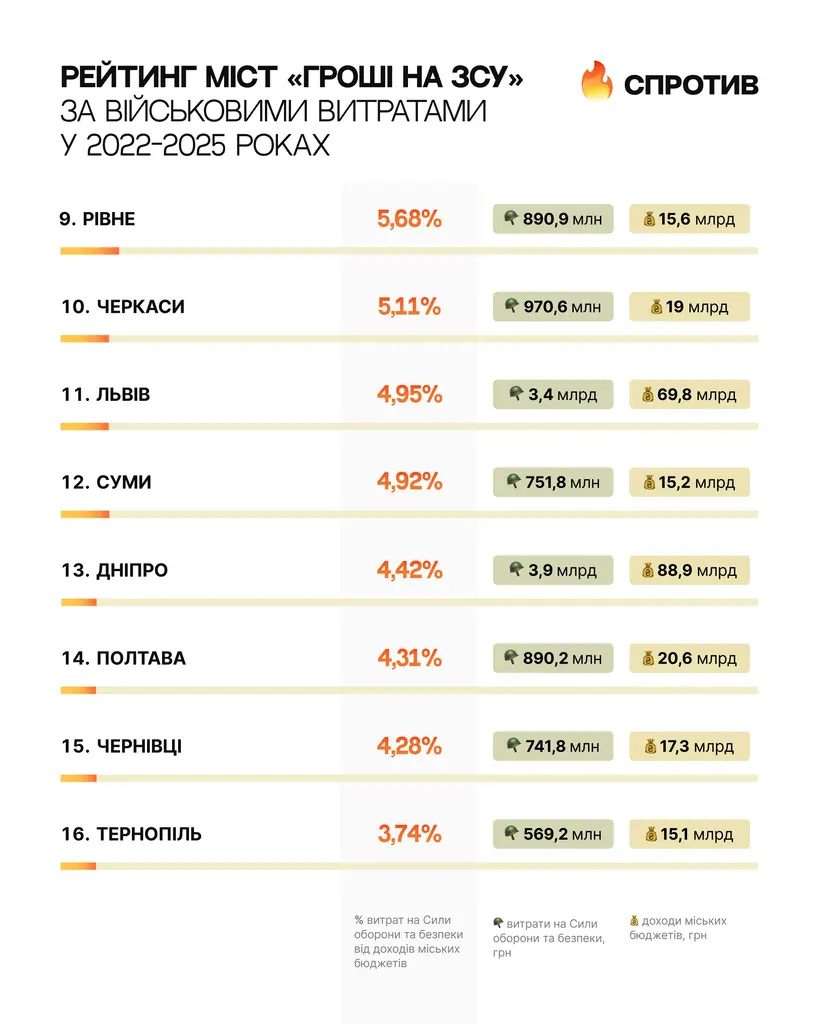
Next come Vinnytsia - 7.80%, Kyiv - 7.71%, Chernihiv - 7.34%, Odesa - 5.99%, Lutsk - 5.69%, Rivne - 5.68% and Cherkasy - 5.11%.
So even the richest city in the country did not top the rating. Kyiv spent the most in absolute terms - UAH 27.4 billion, but relative to city budget revenues that is 7.71% and only fifth place among regional centres.
§ 02Kharkiv, Kherson and Kropyvnytskyi - at the bottom of the rating
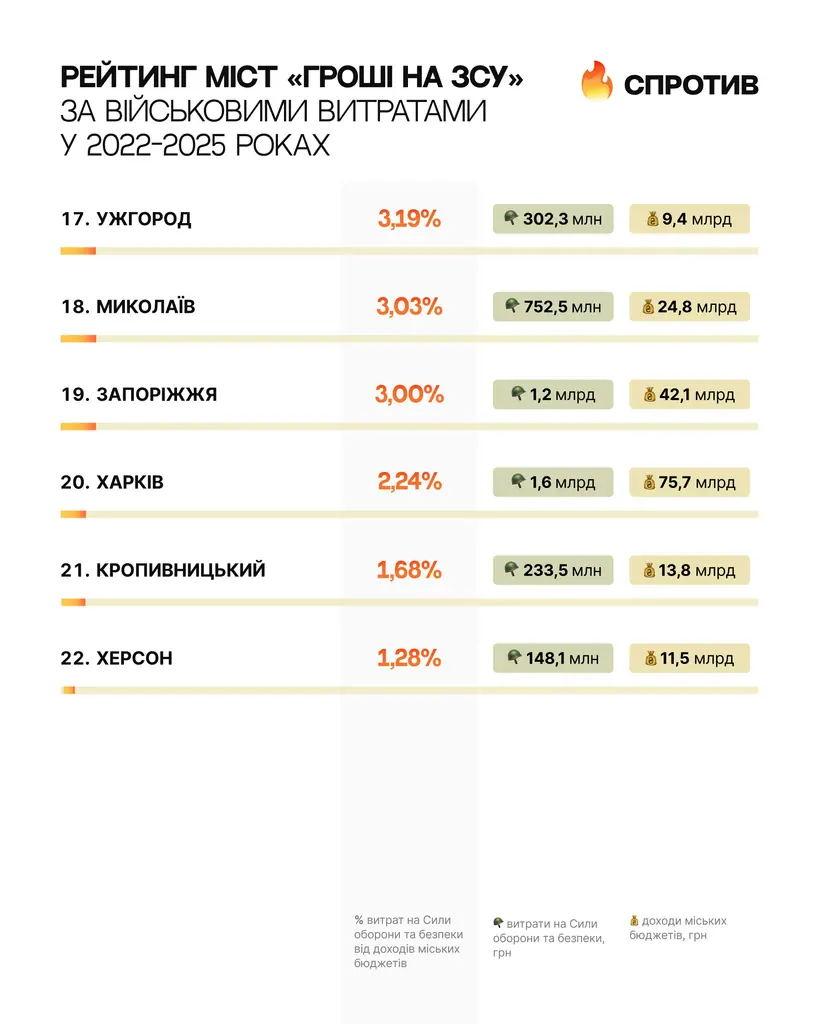
The lowest figure among the regional centres analysed is Kherson - 1.28%. Over the period studied - UAH 148.1 million with UAH 11.5 billion in budget revenues.
Second to last is Kropyvnytskyi - 1.68%, or UAH 233.5 million out of UAH 13.8 billion.
Kharkiv, one of the largest Ukrainian cities and one of the hardest hit by Russian attacks, came 20th - 2.24%. In 2022-2025 about UAH 1.6 billion was directed to the Defence and Security Forces with budget revenues of UAH 75.7 billion.
Zaporizhzhia has 3%, Mykolaiv - 3.03%, Uzhhorod - 3.19%.
§ 03On average - only 5.97%
One of the main conclusions of the study is that the average share of military spending actually allocated from city revenues in 2022-2025 is only 5.97%.
At the same time, none of the 60 cities studied by RESISTANCE met the demand of the "Money for the AFU" protests - to direct 20% of city budget revenues to defence needs.
This is especially important given that local budget revenues changed over the period studied. The analysis showed that an increase in city resources did not always mean a proportional increase in aid to the army.
In 2025 only about 10% of the additional resources that cities received thanks to revenue growth compared to the previous year went to military needs. In 2024 the figure was 4.7%, in 2023 about 30%.
§ 04Protests work: an extra UAH 8.9 billion in three months
The rating showed another important pattern: public pressure gets results.
In just three months of 2023 - during the most active phase of the nationwide "Money for the AFU" protests - cities additionally allocated UAH 8.9 billion to finance the Defence and Security Forces.
On the most active days of the protests, over 50 thousand people took to the streets simultaneously in 150 Ukrainian cities.
Ukrainians demanded that local authorities review budget priorities: in a country fighting a full-scale war, money must first of all work for defence capability.
And the figures show that after public pressure, the money was found.
§ 05Why we count percentages, not just billions
An absolute sum can create a false impression. A city with a budget of hundreds of billions of hryvnias can naturally spend more than a city with a budget of UAH 15-20 billion.
That is why RESISTANCE compares military spending with the revenues of each specific city.
For example, Lviv spent about UAH 3.4 billion - almost as much as Odesa. But for Lviv that is 4.95% of budget revenues, and for Odesa 5.99%.
Dnipro spent even more - about UAH 3.9 billion. However, because of its much larger budget, its figure is 4.42%.
This comparison shows not just who spent more money, but for whom financing defence was really a budget priority.
§ 06From city budgets to real support for the army
"Money for the AFU" is not a competition between cities for a nice place in a table. It is a way to give citizens a tool to control how the authorities manage public funds during the war.
Behind every figure in a budget there is a choice: where to direct the community's limited resources and what place defence takes among these priorities.
The experience of 2023 has already shown: when citizens ask questions, protest and demand budget reviews, the authorities' decisions change and money for the army is found.
The full rating table of 60 cities, the research methodology and the official replies of city councils are available on RESISTANCE MEDIA.
Monitor your city's budget. Ask how much money goes to defence. Demand accountability. And join RESISTANCE - because where our money goes also depends on our participation.